Content is being developed.
![Sense Atölye logo]() Sense Atölye
Sense Atölye is the measurement component I am developing to work with the sensors envisioned for my longevity architecture research. The architectural aim is to establish a study platform that can consider observations of daily life together with the environmental conditions of a space. Sense Atölye is a research application I am developing to monitor motion and cardiac signals from a wearable sensor on a Mac, record them with person and session information, and examine the same measurement through different views. The focus extends beyond displaying a single number: waveform, timing, recording conditions and gaps in the data remain visible together. Raw measurement, calculated results and AI explanation are kept separate.
Purpose
The meaning of a sensor measurement depends on who the recording belongs to, how the sensor is used and when the connection is interrupted. Sense Atölye connects this information within one workspace, aiming for a traceable measurement process from the live graph to the person folder, dated session and reopened recording.
A shared development principle is to distinguish a simplified display from the original recorded data. Reducing samples for the screen does not change the raw recording; missing data is not replaced with invented results. Personal investigation of motion and physiological signals is the current field of work. Ergonomics, working environments and structural vibration are research directions that require their own measurement methods and separate validation.
The longevity architecture connection: Measurement research for the Home Health OS concept in Prototype 01 aims to relate a person’s motion and cardiac data to environmental observations within their time and usage context. The current wearable application is an initial component under development. Building sensors, environmental data and connections to architectural automation will require separate implementation and acceptance trials.
Applications
Live measurement investigation: Monitor acceleration, rotation, magnetic and cardiac channels while the sensor is connected, examining waveforms, sample counts and connection state together.
Person and session archive: Keep measurements from different dates together for the same person and reopen a selected recording. A comprehensive comparison view across dates is part of the development plan.
Motion and signal research: Examine changes through time graphs, frequency distributions and relationships between two axes. These views do not automatically identify body position or movement type.
Overnight recording trials: Collect cardiac and motion streams in a longer session, separating connection gaps, events marked by the person and candidates for investigation. An overnight recording is not presented as sleep-stage measurement.
Research and prototype development: Establish a workspace for recording, calculating and explaining measurement data, and evaluate new applications through real field trials.
Longevity architecture research: Plan measurement-led investigations of how design decisions such as the courtyard, sleep suite, working areas and recovery spaces are used in daily life. Relate current motion and cardiac recordings to future building and environmental sensors while keeping their sources distinct; a single measurement does not establish an architectural benefit or health outcome.
Workflow
1. Prepare the person and recording location. Person identity, owner information and a dated session follow the same recording structure.
2. Connect the sensor to the Mac through Bluetooth. Up to four streams can run simultaneously from six channel options. Channel settings are locked during a recording or overnight session so that the channel structure of an ongoing recording remains consistent.
3. Monitor the data in the appropriate view. Sample count, requested sampling rate and time gaps appear alongside the graph. Original packets and decoded measurements are stored in local recording folders.
4. Reopen the recording from the archive. The overnight module also keeps minute summaries, connection segments and event markers. A short real-device trial produced a numerical report, PDF and separate AI explanation; final acceptance of whole-night stability and spoken presentation is ongoing.
Areas of work
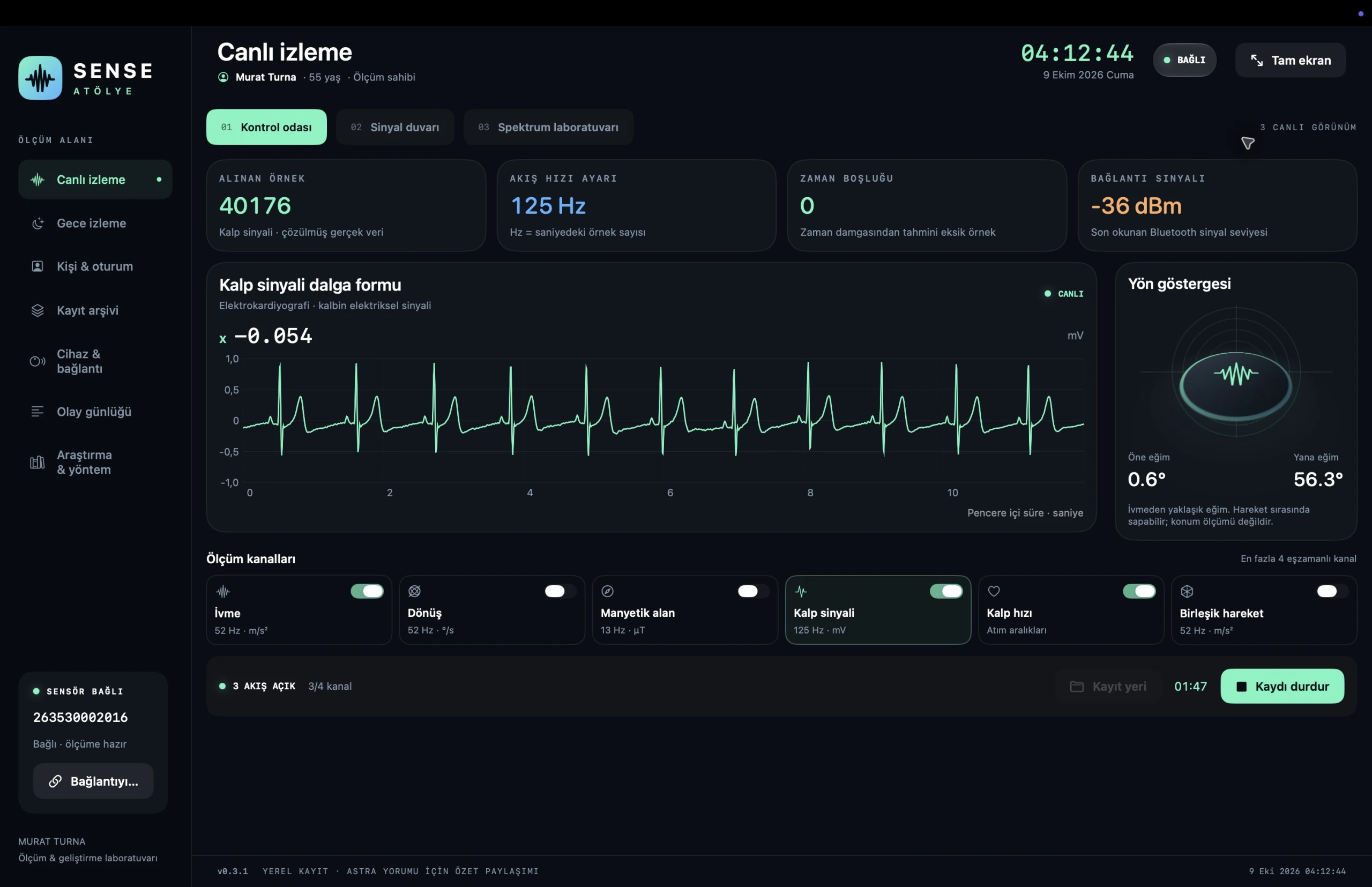
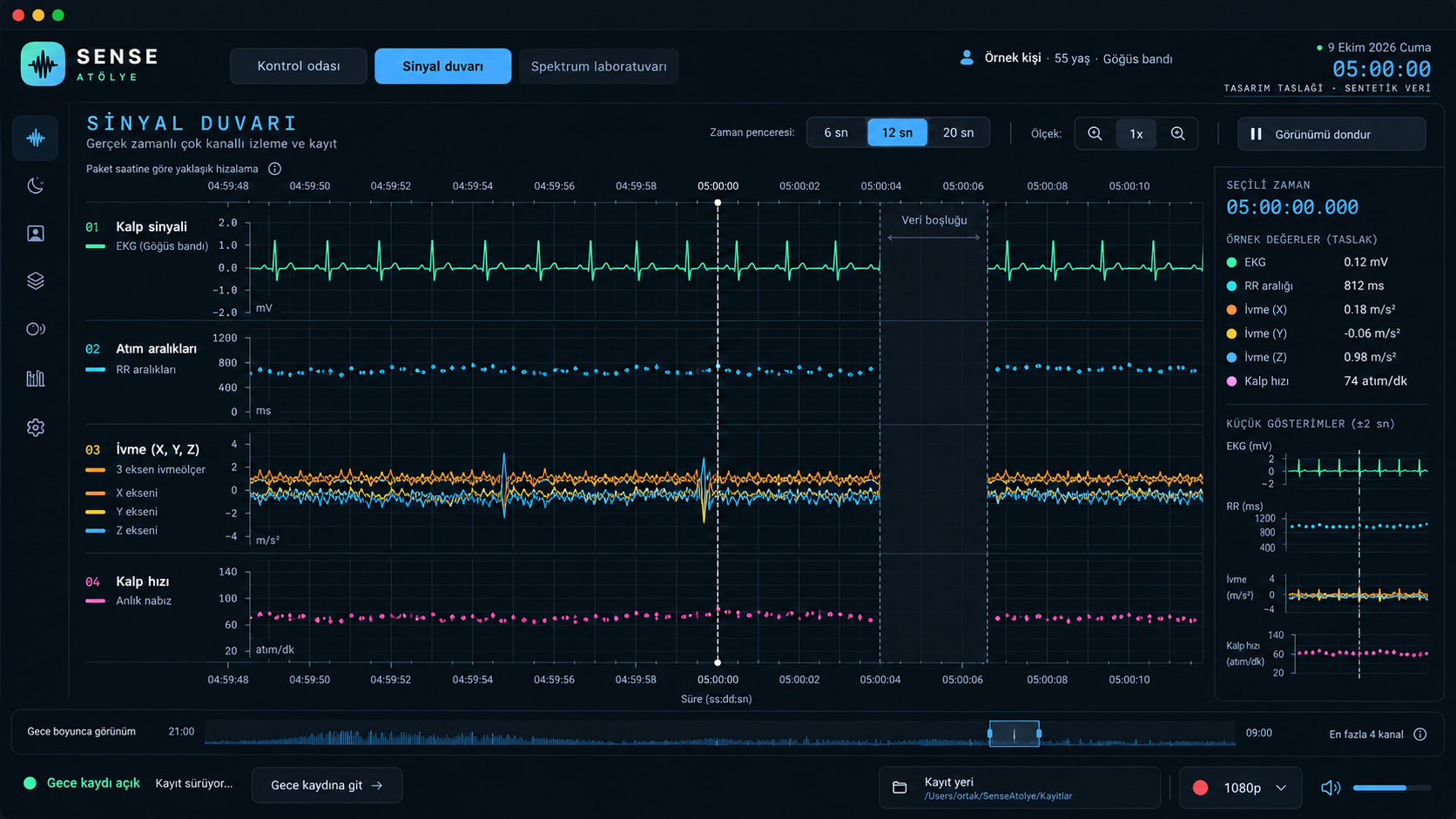
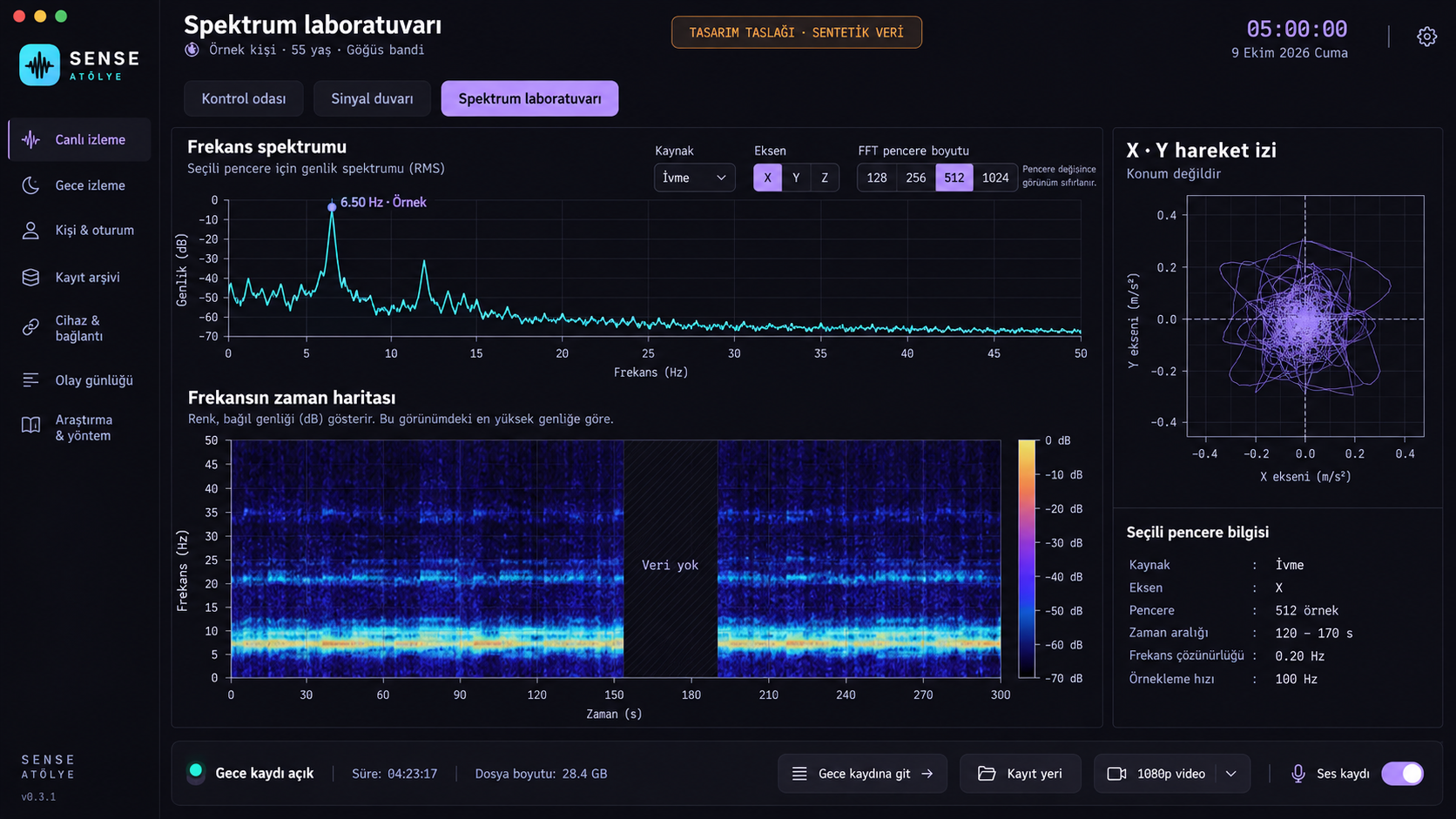
- Three live views: Control room combines the selected measurement graph with basic indicators. Signal wall displays channels in separate panels. Spectrum laboratory shows frequency distribution, X–Y axis relationships and a relative frequency history collected while the view is open. The X–Y trace is not position tracking.
- Six measurement options: Three-axis acceleration, three-axis rotation, three-axis magnetic field, electrocardiography (ECG), heart rate and combined six-axis motion. Current panel settings are 52 Hz for acceleration, rotation and combined motion, 13 Hz for magnetic field and 125 Hz for ECG. Hertz (Hz) means samples per second. Heart rate is event-based; these settings are not presented as every rate the device could support.
- Channel management: A maximum of four measurement streams runs simultaneously. Closing is confirmed by the Bluetooth write acknowledgement and the actual end of the data stream; a toggle may briefly remain pending during confirmation. Channel selection is locked while recording.
- Person and local archive: A persistent person identifier, readable person folders and dated sessions connect the owner to the recording. Changing the person form later does not change the owner of an earlier session. Reopened archive data is examined separately from the live stream.
- Preserving raw data: Original Bluetooth packets, sensor timestamps and decoded samples are recorded. CSV, or comma-separated values, files can be examined in spreadsheet and analysis tools. Reducing samples for display does not reduce the raw files.
- Experimental overnight module: ECG, heart rate and acceleration are prepared together; RR intervals, the time between heartbeats, are also preserved. Minute summaries, data gaps, recording segments after disconnection and person-marked events are stored separately. Creating a new segment after a connection refresh was verified in a short real-device trial. Automatically resuming an unfinished night after restarting the application is not yet available.
- Reports and explanation: The local numerical report and interpretation generated by OpenAI GPT-6 Astra are separate files. Portable Document Format (PDF) outputs were produced in a short trial. A Turkish read-aloud interface is available; development and real-use trials of the spoken presentation are ongoing.
Outputs
Original Bluetooth packets, channel-based CSV measurement files and a recording summary containing person and session information.
Dated measurements that can be reopened from the archive; minute summaries, recording segments, data gaps and event lists with distinct sources in overnight trials.
A local numerical report and PDF from the overnight module, followed by a separate post-session AI explanation and its PDF. Interpretation does not replace the recorded measurement.
This page includes a real 0.3.1 panel screenshot supplied by the user. One-button panel video capture remains a planned output.
Planned development
Make measurement quality more visible: Evaluate electrode contact, signal sufficiency and motion-related noise, and avoid producing rhythm conclusions without quality control.
Compare recordings from different dates: Develop a separate analysis view that examines sessions collected under comparable conditions, including numerical differences, recording duration and data sufficiency.
Expand recording context: Add sensor placement, conditions of use and placement notes to general sessions, extending beyond the overnight module.
Improve long-recording reliability: Work on real whole-night acceptance, battery and connection interruptions, reopening the application, cancellation and retry paths, file integrity and report layout.
Visual and spoken presentation: One-button panel video, clearer report pages and experimental sound paced by actual beat intervals. This does not represent a heart sound that the sensor did not measure or provide a clinical alarm.
Mobile and field management: Device management from iPhone/iPad, starting and downloading recordings in the sensor’s own memory, and separate connection layers for other sensors. The existence of the Mac panel does not mean these mobile features are ready.
New research directions: Evaluate work demand and ergonomics, architectural working environments, structural vibration and aquatic motion through separate pilots. Hardware suitability, measurement methods and acceptance conditions will be tested for each field.
Architectural integration: Develop separate connection layers for building and environmental sensors, time alignment, protection of personal data and a control approach in which the person retains the final decision. Air, illuminance, temperature and other environmental channels are not presented as ready features of the current wearable sensor application.
Images and work examples
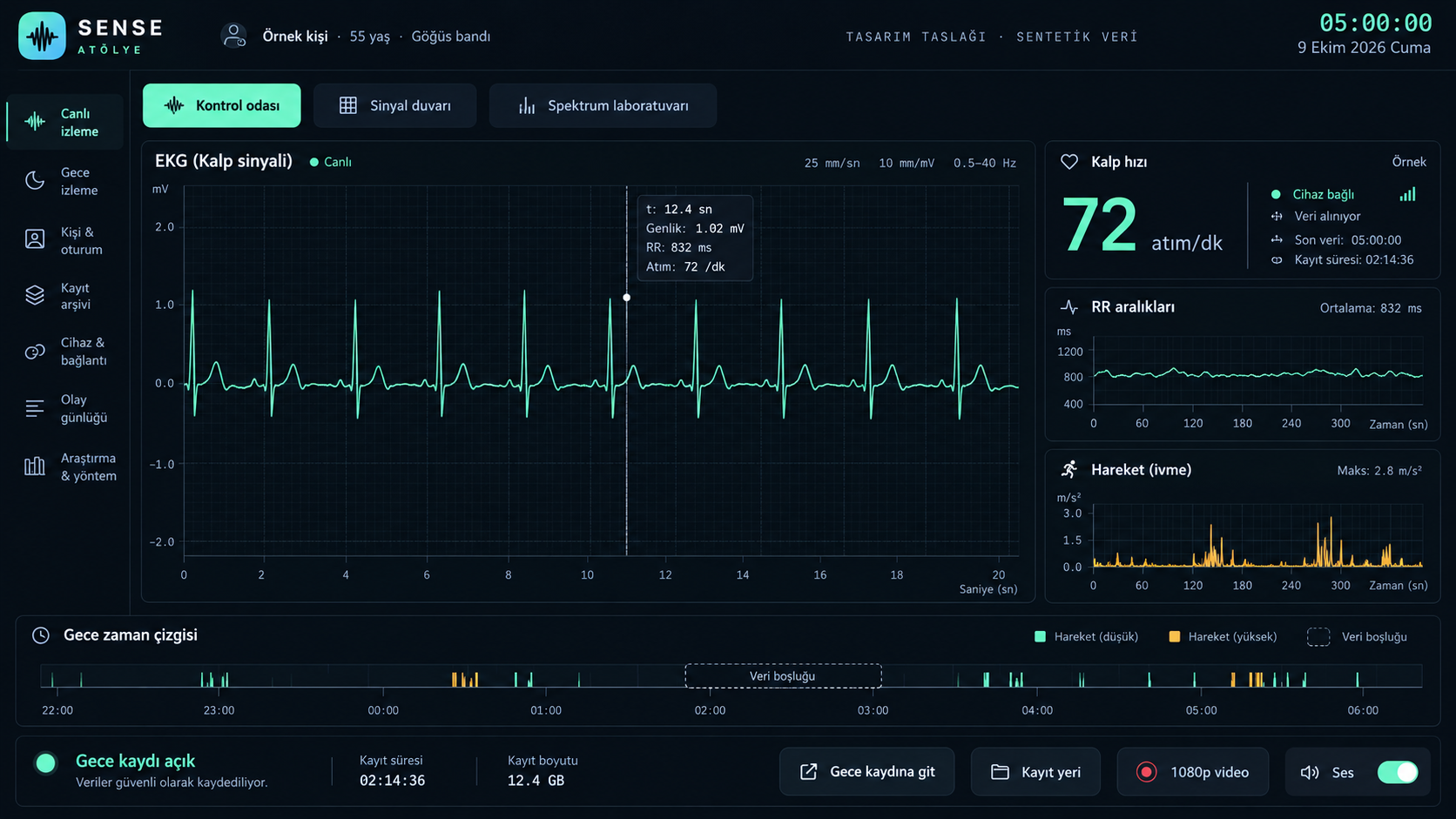
The actual Mac interface of Sense Atölye 0.3.1. Control room brings together a live ECG waveform, measurement channels, connection indicators and the recording bar. The screenshot was supplied by the user on 9 October 2026.
Three interface drafts explore different ways to read the same measurement: Control room, Signal wall and Spectrum laboratory. These drafts use synthetic data created for illustration. The actual application screenshot and the design drafts are identified separately below each image.
Development status
As of 9 October 2026, the Mac-based 0.3.1 application has been used with a real sensor in live measurement and short recording trials. Work continues on whole-night data integrity, different disconnection conditions, final acceptance of all views and spoken presentation. This research prototype does not offer medical diagnosis, clinically validated rhythm analysis, sleep-stage measurement or an emergency alarm service. The approximate tilt indicator is not a position measurement.
Raw measurement files are stored locally on the Mac. Completing an overnight session through its finish action starts the Astra explanation and sends a measurement summary to OpenAI with the person’s name and device serial number removed; the raw overnight waveform is not included in that summary. Because of the processing context, the entire transfer is not claimed to be completely anonymous or to keep every piece of data on the computer in all circumstances.
Research documents have evaluated work demand and ergonomics, structural vibration and aquatic exercise as distinct application directions. These are not ready services released for general use within Sense Atölye; methods, field data, licensing and conditions of use require separate evaluation.
Access and introduction
Sense Atölye is a native research prototype developed for macOS 15 and later. This page does not announce a general download or commercial release. Please contact me about the project scope and possible research collaborations. Windows and iPhone/iPad versions require separate development and real-device validation.